Description
Navigating EEOC claims 2026 is becoming a top compliance and litigation priority for U.S. employers following the U.S. Equal Employment Opportunity Commission’s decision on January 22, 2026, to rescind its Enforcement Guidance on Harassment in the Workplace. This marks one of the first major regulatory acts since the EEOC achieved a quorum in October 2025.
While the rescission of the 2024 harassment guidance reflects shifting federal enforcement priorities, it does not alter an employer’s baseline obligations to maintain harassment-free workplaces under federal anti-discrimination laws. However, it does raise critical questions regarding obligations to prohibit harassment based on gender identity. In 2026, organizations face expanded enforcement priorities, increased scrutiny of investigation practices, and heightened expectations for data transparency—shaped in part by federal workforce initiatives connected to the One Big Beautiful Act (OBBA).
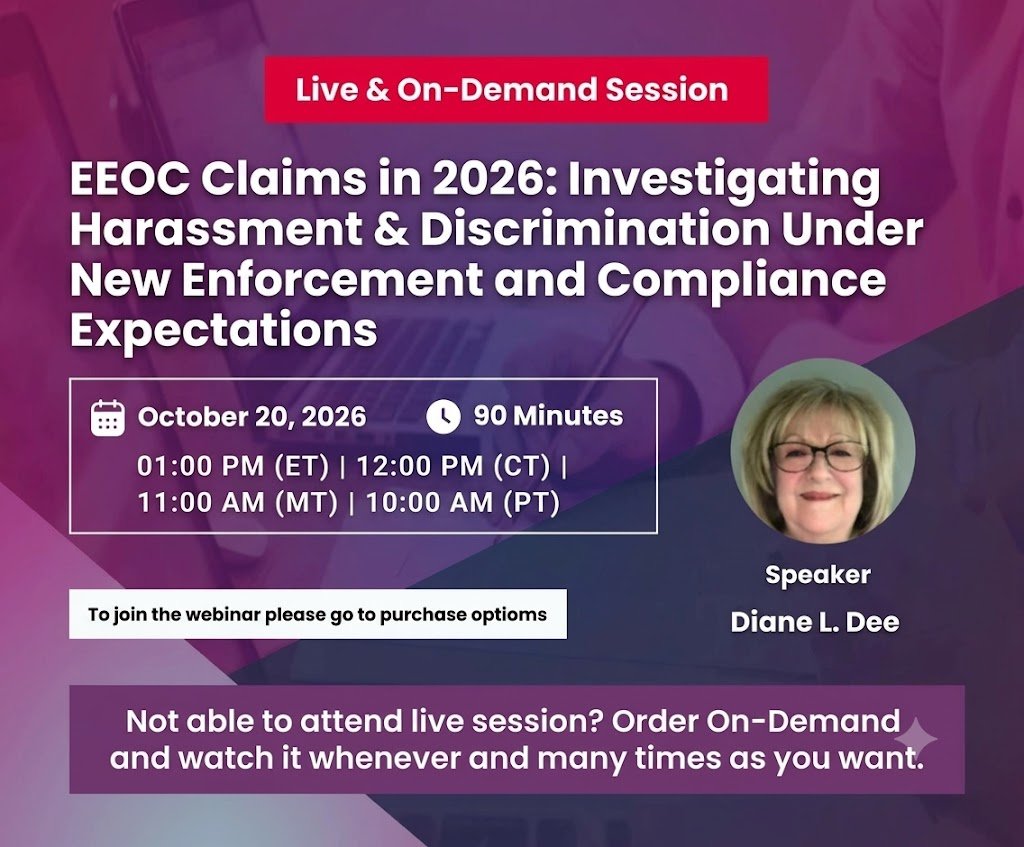
In this timely and practical session, Ms. Diane L. Dee will guide employers through how to properly respond to EEOC charges, manage internal investigations, and align workplace practices with EEOC claims 2026 compliance expectations and digital agency procedures.
Attendees will leave with a clear, step-by-step understanding of how to conduct legally defensible investigations, prepare accurate employer responses, and remain audit-ready in an increasingly data-driven environment.
Why Should You Attend:
-
Understand how EEOC claims 2026 enforcement priorities and investigation standards affect your organization’s risk and response strategy
-
Learn how employer documentation, reporting, and data practices are influenced by workforce accountability measures associated with the One Big Beautiful Act (OBBA)
-
Gain clarity on how to properly manage EEOC forms, employer submissions, and digital charge-handling systems
-
Reduce exposure to retaliation, procedural errors, and inconsistent internal investigations
-
Strengthen your organization’s ability to respond confidently to EEOC audits, charges, and information requests
Managing EEOC Claims 2026: Enforcement Priorities & Investigations:
-
EEOC Enforcement Focus: Systemic discrimination initiatives impacting employer investigations
-
Updated Standards: Evolving interpretations of protected classes and intersectional harassment claims
-
Charge Management: EEOC Charge of Discrimination (Form 5) and Notice of Charge / RFI digital portal updates
-
Employer Submissions: Best practices for position statements, supporting evidence formatting, and confidentiality
-
Workforce Reporting: EEO-1 Component 1 filing considerations and data utilization in discrimination investigations
-
Audit & Retention Readiness: Record retention and investigation file standards influenced by the One Big Beautiful Act (OBBA)
-
Remote & Hybrid Workplaces: Compliance risks and investigation techniques for distributed teams
-
Investigator Standards: Independence, neutrality, and credibility frameworks for internal investigations
-
Manager Obligations: Supervisor reporting requirements under updated employer liability standards
-
Dispute Resolution: Preparing for EEOC audits, subpoenas, and mediation processes
Who Should Attend:
-
HR Directors, HR Managers, and HR Business Partners
-
Compliance, Risk, and Governance leaders
-
Managers and supervisors involved in complaint handling and investigations
Conclusion:
Stay ahead of regulatory shifts, improve your investigation workflows, and ensure your organization is fully prepared for evolving compliance standards influenced by the One Big Beautiful Act (OBBA) and today’s changing workplace environment.
Ask your question directly from our expert during the Q&A session following the live event.
 Pedu is recognized by SHRM to offer Professional Development Credits (PDCs) for the SHRM-CPSM or SHRM-SCPSM. This program is valid for 1.5 PDCs for the SHRM-CPSM or SHRM-SCPSM. For more information about certification or recertification, please portal.shrm.org.
 This Program has been approved for 1.5 HR (General) recertification credit hours toward aPHR™, aPHRi™, PHR®, PHRca®, SPHR®, GPHR®, PHRi™, and SPHRi™ recertification through HR Certification Institute®? (HRCI®).